
10 Longest-Range Private Jets in 2026 Ranked by Range

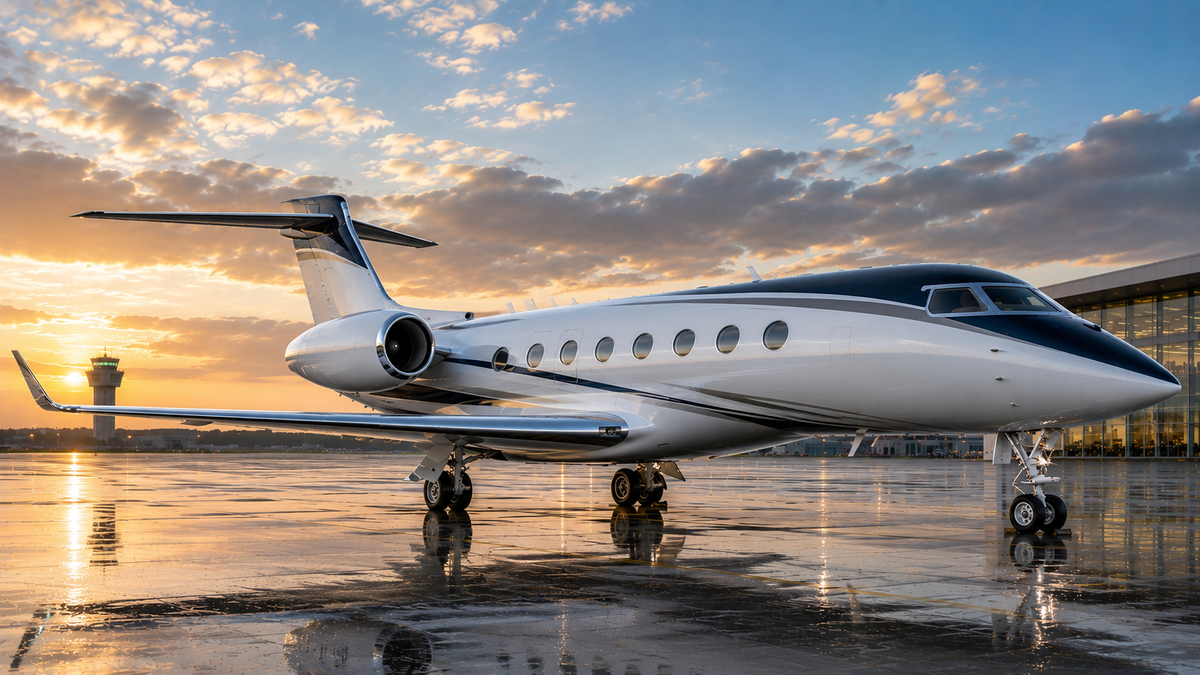
The longest-range private jets in 2026 can fly about 8,000 nautical miles, giving you access to more nonstop intercontinental flights than ever before. Models like the Gulfstream G800 and Bombardier Global 8000 lead the pack. Other flagship aircraft offer solid range, roomy cabins, and impressive operating flexibility.
Range isn’t the only thing that matters for your global travel plans. You’ll want to think about payload, weather, airport options, cabin comfort, and how you actually plan to use your jet.
This guide compares the 10 longest-range private jets and digs into how certified range numbers translate into real-world business aviation missions. We’re talking about nonstop flights between global cities and long-haul trips with a full cabin.
How Range Rankings Are Measured
Range rankings rely on published aircraft data, but the numbers only mean something if you compare the same reserve rules, payload, speed, and weather assumptions. Your actual nonstop range might come up short of the advertised figure.
NBAA IFR Reserves, Payload, and Weather
Most business jet range figures use NBAA IFR reserve planning. This means you fly to your destination, make a missed approach, then keep enough fuel to fly another 100 nautical miles at normal cruise.
That reserve standard helps you compare planes fairly, but not every operator uses the same plan. Your crew might need more reserve fuel because of airport rules, company policy, or alternate-airport needs.
Payload changes the story too. More passengers, bags, catering, and crew gear add weight, which increases fuel burn. A jet listed with an 8,200 nautical mile range probably won’t make it that far with every seat filled and heavy luggage.
Weather can be a game-changer. Strong headwinds can shave off hundreds of nautical miles, while tailwinds might give you a boost. Treat published range as a planning guide, not a guarantee.
Cruise Speed Versus Maximum Range
Manufacturers usually publish maximum range at an efficient long-range cruise, usually around Mach 0.85. At that speed, the aircraft sips less fuel per mile.
If you fly faster, you’ll get there sooner—but at the cost of range. Cruising near Mach 0.90 might make sense if your schedule is tight. Only certain jets can cruise at speeds close to Mach 0.94, and fuel burn jumps up sharply.
| Cruise choice | Effect on your mission |
|---|---|
| Long-range cruise, about Mach 0.85 | Maximizes published range |
| High-speed cruise, about Mach 0.90 | Saves time but uses more fuel |
| Very high speed, up to Mach 0.94 | Prioritizes speed over maximum range |
For example, a jet rated for 8,000 nautical miles at long-range cruise might need a fuel stop if you fly faster, pack it full, or run into headwinds.
Why Real-World Mission Planning Matters
A range ranking shows which jets have the longest theoretical reach. It doesn’t tell you if the aircraft fits your usual trips.
You’ll want to match the jet’s range to your real city pairs, passenger count, and baggage needs. Sometimes a 7,700 nautical mile jet covers your longest regular routes just fine, even if another model can fly 8,000 or 8,200 under perfect conditions.
Your crew also has to plan for airport altitude, runway length, seasonal temps, winds aloft, and alternate airports. These factors can limit takeoff weight or require more fuel.
For long-haul flights, focus on mission fit instead of just the highest range. The best jet gives you reliable nonstop trips on your usual routes and meets your speed, cabin, and operating needs.
The New Distance Leaders
These ultra-long-range business jets—like the Gulfstream G800, Bombardier Global 8000, and Gulfstream G700—sit at the top of the 2026 range list. They’re built for long intercontinental routes, with fewer fuel stops and more space.
1. Gulfstream G800
The Gulfstream G800 leads with a certified range of 8,200 nautical miles. You can fly New York to Hong Kong or London to Perth nonstop—if weather, payload, and air traffic cooperate.
Two Rolls-Royce Pearl 700 engines power it. The G800 can hit speeds close to Mach 0.94, but its normal cruise setting helps save fuel for those really long trips.
Inside, you get up to four cabin living areas—seating, dining, work, and rest spaces, all arranged for your trip. Gulfstream touts a low cabin altitude, which can help cut down on fatigue during 15-hour-plus flights.
2. Bombardier Global 8000
The Bombardier Global 8000 offers a range of 8,000 nautical miles, putting it just behind the G800. You get practical nonstop access between major cities in North America, Europe, Asia, and the Middle East.
It’s got a published top speed of Mach 0.94. That high-speed capability can shave time off long trips, but your actual flight time depends on winds, routing, payload, and limits.
Its four-zone cabin lets you separate work, meals, rest, and private space. Bombardier also designed it with a low cabin altitude at cruise, so you’ll hopefully feel fresher after a long flight.
3. Gulfstream G700
The Gulfstream G700 has a range of 7,750 nautical miles and is still one of the most capable ultra-long-range jets you can buy. You can fly nonstop between the US and the Middle East or Asia.
Like the G800, the G700 uses Rolls-Royce Pearl 700 engines. It can reach speeds close to Mach 0.94, so you can prioritize speed if your route and fuel plan allow it.
The G700’s cabin offers up to five living areas, which is bigger than many competing jets. You can set up spaces for meetings, dining, sleeping, and even a private rear suite. Its low cabin altitude helps with comfort on those marathon flights.
Proven Flagships and Emerging Contenders
These business jets combine long intercontinental range, big cabins, and strong support networks. Some are still in production, while others are mostly found pre-owned.
4. Bombardier Global 7500
The Bombardier Global 7500 has a published range of 7,700 nautical miles at Mach 0.85. You can fly New York to Hong Kong or Los Angeles to Sydney if you plan your payload and catch favorable winds.
It cruises up to Mach 0.90, with a top speed of Mach 0.925. The Smooth Flĕx Wing design aims to improve ride quality and short-field performance.
The cabin gives you up to four separate living areas, including a rear bedroom. This layout can make long flights a lot more manageable, since passengers can work, eat, rest, and meet in their own spaces.
The Global 7500 is one of the most capable certified ultra-long-range aircraft in service. Its large operator base supports resale, maintenance, and charter options.
5. Dassault Falcon 10X
The Dassault Falcon 10X is an upcoming ultra-long-range jet with a planned range of 7,500 nautical miles at Mach 0.85. Dassault hasn’t delivered it yet, so take the range and performance numbers as targets for now.
It’ll use two Rolls-Royce Pearl 10X engines, each rated over 18,000 pounds of thrust. Dassault says the Falcon 10X will reach a max speed of Mach 0.925.
The cabin should measure about 6 feet 8 inches high and 9 feet 1 inch wide. You could set it up with a private suite, big lounge, office, or crew rest area.
Dassault also plans advanced flight controls and a system to help it operate from shorter runways than most long-range jets. That flexibility could matter if you fly to airports with limited runway length.
6. Gulfstream G650ER
The Gulfstream G650ER offers a range of 7,000 nautical miles at Mach 0.85. You can use it for long nonstop trips, like New York to Dubai or London to Buenos Aires, if conditions are right.
It flies as fast as Mach 0.925 with two Rolls-Royce BR725 engines. The high-speed cruise can cut your trip time when you need it.
Gulfstream ended G650 production, but the G650ER is still a major player on the pre-owned market. Its long service record means you’ll find experienced pilots, maintenance, and plenty of used aircraft.
The cabin is about 6 feet 5 inches high and seats up to 19 in some layouts. Many owners like the G650ER for its balance of range, speed, cabin size, and proven history.
7. Gulfstream G550
The Gulfstream G550 has a range of 6,750 nautical miles at Mach 0.80. While newer jets fly farther, this one still covers plenty of long international routes without a stop.
It runs on two Rolls-Royce BR710 engines and can hit a max speed of Mach 0.885. Normal high-speed cruise is around Mach 0.85.
Gulfstream stopped building the G550 in 2021, so you’ll only find it pre-owned. Its long production run created a big global fleet and strong support network.
The G550 cabin is smaller than the G650 or newer jets, but it’s still practical for long flights. If you want a proven large-cabin jet with solid range and a lower price than the latest flagships, the G550 makes sense.
Long-Range Aircraft With Operational Flexibility
These heavy jets combine intercontinental range with good airport access, reliable systems, and useful cabin space. They’re a good fit if your trips mix major hubs, remote airfields, or shifting schedules.
8. Dassault Falcon 8X
The Dassault Falcon 8X has a published range of about 6,450 nautical miles. You can fly London to Singapore or New York to Dubai nonstop, as long as conditions cooperate.
Its three-engine design gives you strong performance at high-elevation airports and on shorter runways. That opens up more options if you need to use remote or limited airports.
The Falcon 8X cabin layout is flexible for 14 to 16 passengers, depending on the interior. It’s longer than the Falcon 7X, though the newer Falcon 6X is wider but doesn’t have the same range.
Dassault’s EASy flight deck and support network help with reliability. Still, if you’re buying pre-owned, check the maintenance history—especially since early Falcon 8X deliveries started in 2016.
9. Bombardier Global Express XRS
The Bombardier Global Express XRS offers a range of about 6,150 nautical miles. It’s a solid pick if you want a large-cabin jet for long international trips but don’t want to pay for a brand-new Global model.
You’ll find a spacious three-zone cabin, usually seating 14 to 16. Many have a private rear area, big galley, and separate crew rest space, which is great for flights over 10 hours.
The XRS is an earlier Global family version, built before the Global 6000. Its range beats many super-midsize jets, but the cabin systems and avionics can feel dated unless upgraded.
When comparing listings, check engine program coverage, interior condition, and avionics updates. These factors affect costs and reliability more than just the model name.
10. Bombardier Global 6000
The Bombardier Global 6000 has a published range of about 6,000 nautical miles. You can fly nonstop between cities like Los Angeles and London, or Dubai and Tokyo, depending on weather, passenger count, and flight planning.
Bombardier built this heavy jet as an update to the Global Express XRS. You’ll find newer avionics, a more comfortable cabin, and slightly better cruise performance than the older Global Express.
Its wide, long cabin typically holds 13 to 17 passengers in three areas. You can work, eat, and rest on long flights, and the crew has a dedicated space to keep up with demanding schedules.
The Global 6000 has a broad operator base and solid maintenance support, which helps with reliability. While it doesn't match the range of the Gulfstream G800 or Bombardier Global 8000, it’s still a practical choice for frequent intercontinental travel.
Cabin Comfort and Productivity on Long Missions
On flights lasting 10 to 16 hours, comfort really depends on air quality, space, quiet work areas, and whether you can actually sleep. Jets like the Gulfstream G800 and Bombardier Global 8000 combine long range with large, well-equipped cabins.
Cabin Altitude, Fresh Air, and Humidity Control
Low cabin altitude can make a huge difference in how you feel after a long flight. The Gulfstream G800 and G700 can keep cabin altitude near 2,840 feet at cruise, which is impressive. The Global 8000 is similar, with a cabin altitude around 2,900 feet.
Most ultra-long-range jets use 100% fresh air rather than recirculated air. These systems regularly replace the cabin air, and filtration helps keep things clean.
Humidity control is still pretty limited in most jets because the outside air is so dry at altitude. It’s worth asking the operator if the aircraft has humidification equipment, since not every model includes it.
Cabin Volume, Privacy, and Sleeping Arrangements
Cabin volume really impacts how well you can work, eat, move, and relax on a long flight. A stand-up, flat-floor cabin lets you walk around without ducking or tripping over raised floors.
Big jets like the Global 7500, Global 8000, G700, and G800 can have several zones. You might get a lounge for meetings, a dining area, a quiet workspace, and a private suite in back.
For overnight flights, check how many real sleeping spots there are. Some layouts have a master suite with a fixed bed and private lavatory, while others use convertible divans. A private suite gives you better separation from colleagues, crew, and noise.
Connectivity, Lighting, and Arrival Readiness
Reliable inflight Wi-Fi lets you use email, make calls, and access cloud files even over the ocean. Before you book or buy, ask about internet speed, coverage, and if everyone can use video meetings at once.
Cabin systems matter too. Touchscreen controls can adjust temperature, window shades, entertainment, and lighting right from your seat. Some newer jets offer circadian lighting that shifts color and brightness to match your destination’s time.
You can use warmer light for sleep and cooler light for work. With a low cabin altitude, a quiet place to sleep, and a planned meal schedule, you’re more likely to arrive ready for whatever’s next—even if you still feel a little jet-lagged.
Selecting the Right Access and Ownership Strategy
Your annual flight hours, trip patterns, and cabin needs should shape your decision. A long-range jet is only worth it if the access model fits your travel habits.
Full Ownership and Aircraft Management
Full ownership gives you total control over scheduling, crew, cabin layout, and maintenance. It’s a good fit if you fly about 200 to 300 hours a year, need the jet during peak dates, or require a specific plane for regular long-haul routes.
When you’re looking at jets for sale, don’t just focus on the purchase price. You’ll also need to budget for crew salaries, training, insurance, hangar space, maintenance, navigation fees, fuel, and catering. A flight department or aircraft management company can handle dispatch, compliance, maintenance, and charter sales when you’re not using the jet.
Family offices and UHNW individuals often use management companies to keep control but avoid getting bogged down in every detail. You can ask for sustainable aviation fuel where available and use carbon offsets, though neither completely replaces cutting emissions.
Private Jet Charter, Jet Cards, and Fractional Ownership
On-demand charter works if your travel plans change a lot or you fly less than about 50 hours per year. You pay per trip and can pick the right aircraft for each mission, from a super-midsize jet for regional hops to an ultra-long-range jet for intercontinental flights.
A jet card or membership gives you set hourly rates, service standards, and access rules. Jet cards can make booking easier, but you’ll want to check for peak-day limits, fuel surcharges, expiration dates, interchange rules, and how they handle disruptions.
Fractional ownership means you own a share of a specific aircraft type, usually with monthly fees and charges per flight hour. Programs like NetJets and Flexjet offer consistent access, though contract terms vary. This can work if you fly about 50 to 200 hours annually and want more predictability than charter, but don’t want full ownership.
When a VIP Airliner Makes Sense
A VIP airliner makes sense if you regularly carry large groups, need separate work and rest areas, or fly long missions with staff, security, and family. Options include Boeing Business Jets like the BBJ 787-8 and future BBJ 777X models, as well as Airbus Corporate Jets such as the Airbus ACJ320neo.
These planes offer much more space than typical business jets, but they also need bigger airports, specialized crews, more maintenance planning, and higher operating costs. Fees, hangar needs, and repositioning costs can really add up.
You should only go for a VIP airliner if you truly need the space and range. For smaller groups, an ultra-long-range private jet is usually simpler and gets you into more airports.
Frequently Asked Questions
The Gulfstream G800 leads the 2026 business jet range list at 8,200 nautical miles. The Global 8000, G700, and Global 7500 also support many nonstop intercontinental routes.
Which private jet has the longest range in 2026?
The Gulfstream G800 has the longest published range among current ultra-long-range business jets in 2026: 8,200 nautical miles under standard assumptions.
That’s enough for routes like New York to Dubai or London to Perth, if conditions cooperate. Actual distance depends on winds, passenger load, routing, reserves, and airport limits.
What are the top 10 longest-range private jets available in 2026?
Here are some of the longest-range business jets available in 2026:
- Gulfstream G800 — 8,200 nautical miles
- Bombardier Global 8000 — 8,000 nautical miles
- Gulfstream G700 — 7,750 nautical miles
- Bombardier Global 7500 — 7,700 nautical miles
- Gulfstream G650ER — 7,000 nautical miles
- Dassault Falcon 8X — 6,450 nautical miles
- Dassault Falcon 6X — 5,500 nautical miles
- Gulfstream G500 — 5,300 nautical miles
- Embraer Praetor 600 — 4,018 nautical miles
- Bombardier Challenger 650 — 4,000 nautical miles
These range numbers are based on specific test conditions. For real trips, you’ll want to plan for a lower range to account for strong headwinds, alternate airports, and baggage.
How far can the Bombardier Global 8000 fly nonstop?
The Bombardier Global 8000 has a published range of 8,000 nautical miles. That’s about 9,200 statute miles or 14,800 kilometers.
You can use it for city pairs like Los Angeles to Singapore or New York to Hong Kong, again depending on conditions. The cabin holds up to 19 passengers in a large-cabin layout.
What is the range of the Gulfstream G800 compared with the G700?
The Gulfstream G800 offers a published range of 8,200 nautical miles, while the Gulfstream G700 comes in at 7,750 nautical miles.
That’s about 450 nautical miles more for the G800. You might prefer the G800 for routes that need extra fuel reserve or face strong headwinds, while the G700 gives you a bigger cabin for long international trips.
Which private jets can fly more than 6,000 nautical miles?
Six major business jets have published ranges above 6,000 nautical miles:
- Gulfstream G800
- Bombardier Global 8000
- Gulfstream G700
- Bombardier Global 7500
- Gulfstream G650ER
- Dassault Falcon 8X
These jets can handle nonstop trips between North America, Europe, the Middle East, Asia, and even some parts of the Southern Hemisphere.
What is the best private jet for nonstop long-distance international travel?
The Gulfstream G800 stands out if you want the greatest published range. With its 8,200-nautical-mile capability, you get more route options and extra reserve flexibility compared to most other business jets.
If you care more about cabin comfort, speed, or a spacious interior, you might lean toward the Bombardier Global 8000. The Gulfstream G700 and Global 7500 also work well for long international flights, especially with bigger passenger groups.