
ACMI Wet Lease for Hajj and Umrah Requirements
Assess ACMI wet lease for Hajj and Umrah charter flights requirements, from aircraft approvals and permits to slots, crew planning and passenger care needs.

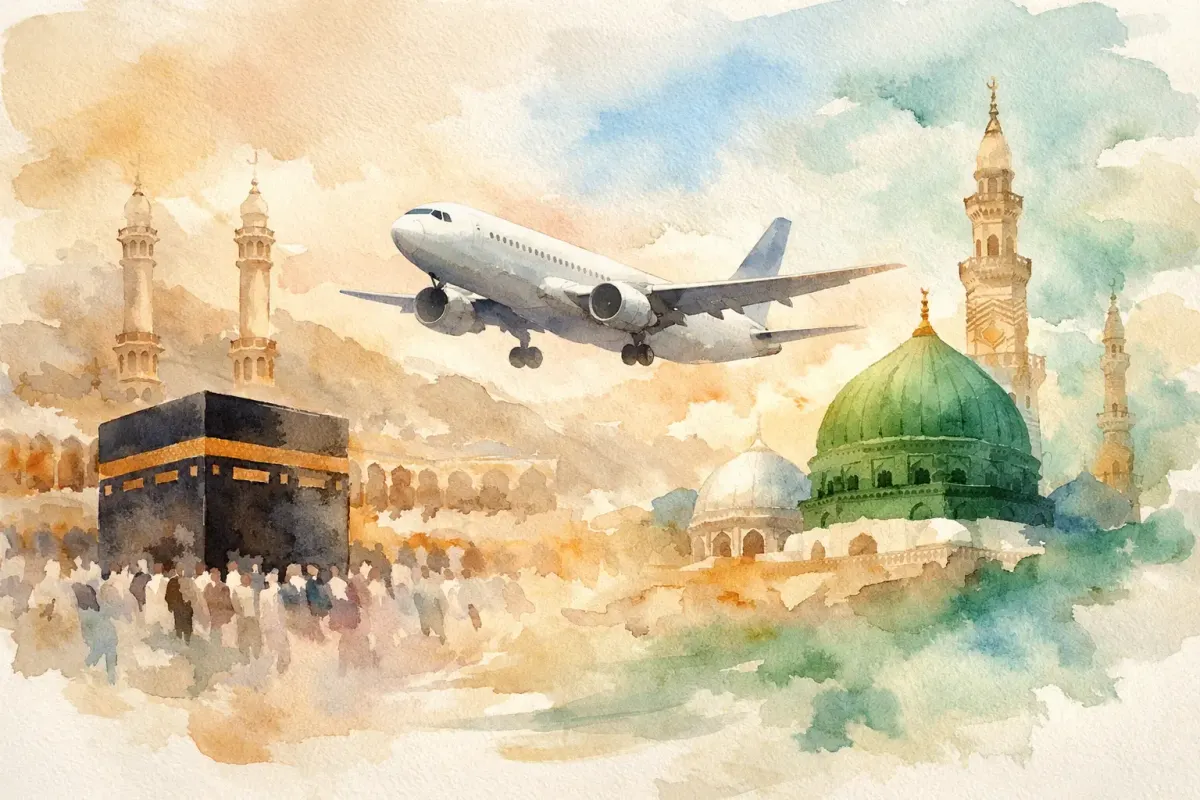
Hajj capacity is not simply a question of finding a large aircraft for a few weeks. An ACMI wet lease for Hajj and Umrah charter flights requirements programme must align aircraft availability, operating approvals, Saudi airport access, pilgrimage schedules and passenger welfare under unusually intense operational pressure. A technically suitable aircraft can still be commercially unusable if slots, permits, ground handling or accommodation arrangements are not secured early.
For tour organisers, airlines, governments and institutional travel planners, the right structure is usually a clearly documented ACMI agreement supported by a specialist charter-management plan. The objective is not merely to add seats. It is to protect the integrity of a time-critical religious travel programme in which a delayed inbound sector can affect thousands of passengers and the viability of the wider schedule.
What an ACMI wet lease includes for pilgrimage flying
Under an ACMI wet lease, the aircraft owner or lessor provides the Aircraft, Crew, Maintenance and Insurance. The lessee generally controls the commercial programme: routes, passenger sales or allocation, charter contracts, ground arrangements and, subject to the agreement, fuel and certain operating charges.
This differs materially from an ad hoc charter. A single charter may suit a limited Umrah group or one-off movement, while an ACMI arrangement is normally used when an airline, tour operator or public body needs dependable capacity across a block of rotations. Hajj programmes often involve concentrated peak dates, high load factors and fixed airport windows. That makes aircraft substitution, crew duty planning and recovery provisions central commercial issues rather than contractual footnotes.
The allocation of responsibility must be explicit. The operating carrier remains responsible for safe aircraft operation under its Air Operator Certificate, including crew competence, maintenance control and operational control as defined by the agreement and applicable rules. The commercial lessee must ensure that its marketing, passenger documentation, local representation and pilgrimage arrangements comply with the rules in every relevant jurisdiction.
ACMI wet lease requirements for Hajj and Umrah charters
The approval path depends on the aircraft registry, operating carrier, country of origin, route rights and the Saudi authorities' requirements for the particular season. There is no single universal checklist that replaces early regulatory engagement.
Operating authority and wet-lease approval
The operating carrier needs a valid Air Operator Certificate with suitable aircraft and route authority. Where the aircraft and crew are supplied by a foreign carrier, both the home-state aviation authority and the authority overseeing the commercial lessee may need to approve the wet lease. Some jurisdictions distinguish between short-term capacity cover and a sustained commercial wet lease, with different notification or approval thresholds.
The arrangement should identify which carrier's flight code and operating identity will be used, who holds operational control, and how passengers will be informed of the operating carrier. Codeshare, consumer disclosure and ticketing rules may apply where a scheduled airline sells seats on wet-leased flights.
For Saudi operations, operators commonly need charter permissions and airport approvals in addition to standard overflight and landing permissions. Requirements can change by season, nationality market and airport, so the programme should be reviewed against the current General Authority of Civil Aviation process rather than assumptions from a previous Hajj season.
Traffic rights, visas and passenger documentation
A wet lease does not create traffic rights. The commercial party must have the authority to carry passengers on the proposed origin-and-destination pair, whether through bilateral rights, a charter permit, a government allocation or another approved mechanism. This is particularly relevant where pilgrims are carried from third countries via an intermediate hub.
Passengers require the appropriate Hajj or Umrah visa and travel documentation. Airlines and tour organisers should not treat document checks as a routine airport task. Incomplete visa data, incorrect names, expired passports or baggage irregularities can create delays that disrupt a tightly scheduled departure bank. A pre-travel document-validation process, with cut-off dates and an escalation route for exceptions, is prudent.
Aircraft suitability and cabin configuration
Wide-body aircraft are often preferred for high-volume Hajj operations, with the Airbus A330, Boeing 777 and Boeing 787 commonly assessed depending on range, airport performance, availability and desired passenger experience. A narrow-body aircraft can work well for regional feeder sectors or shorter Umrah routes, particularly where demand is spread across the year.
The best aircraft is not always the largest available aircraft. An A330 may offer the right balance for a medium-haul programme with constrained demand, while a 777 may be justified on high-density trunk routes. The decision should consider payload at expected temperatures, baggage volume, turnaround infrastructure, spare coverage and the ability to recover passengers if an aircraft becomes unavailable.
Cabin density requires particular care. High-density seating can improve unit economics, but it may be poorly suited to elderly pilgrims, passengers requiring mobility support and long sector lengths. The agreement should specify the approved seating layout, lavatory and galley configuration, wheelchair stowage, special-service procedures and the process for accommodating passengers needing medical assistance.
Slots, airport handling and operating windows
Saudi airport slots are among the most valuable elements of a Hajj programme. Arriving at the correct airport on the wrong day or outside an agreed window may not be operationally acceptable. Jeddah and Madinah demand careful co-ordination during pilgrimage peaks, while departure airports may also face congestion as multiple tour operators schedule similar waves.
Slot requests, handling contracts, parking arrangements and turnaround assumptions should be secured before the ACMI aircraft is committed. Long ground times can alter crew legality, maintenance planning and aircraft utilisation. If the aircraft must reposition between rotations, the cost and risk of those positioning sectors should be included in the programme economics from the start.
Ground handling plans need to cover baggage reconciliation, mobility assistance, water and catering, cleaning, fuelling, security, passenger buses and disruption communications. At high-volume stations, a nominal ground time on paper can prove unachievable without dedicated local co-ordination.
Commercial terms that deserve scrutiny
An ACMI price is typically quoted as a block-hour rate, often with a minimum monthly or total-hour guarantee. That rate is only the base of the financial model. Fuel, airport charges, navigation charges, handling, catering, crew accommodation, crew transport, de-icing where relevant, permits and positioning flights may sit outside the hourly price.
For Hajj, the main risk is often utilisation mismatch. The lessee may guarantee substantial hours but lose productive flying time to slot delays, airport curfews or an uneven return pattern. A contract should therefore define whether guaranteed hours include positioning, what happens when the aircraft is delayed for reasons outside either party's control, and how unused hours are treated.
Availability and replacement-aircraft provisions warrant equal attention. A credible lessor should explain its recovery process, the expected substitute aircraft standard, the time frame for mobilisation and any limits created by permits or airport slots. A replacement aircraft without the necessary approvals may offer little practical value during the Hajj peak.
The agreement should also set out cancellation milestones. Pilgrimage programmes are exposed to geopolitical events, public-health measures, visa changes and demand fluctuations. Deposits, cancellation charges and force-majeure language should reflect the fact that the operator may have committed crew, maintenance capacity and aircraft well before the first departure.
Crew, welfare and disruption planning
ACMI crews remain under the operating carrier's management, but the lessee's schedule can determine whether the programme is workable. High-frequency rotations, overnight delays and extended airport holds affect flight and cabin crew duty limits. Crew hotels, secure transport, visas and local support need to be arranged at every planned overnight location, not only in Saudi Arabia.
Passenger welfare deserves equivalent planning. Pilgrims may be travelling in large family groups, may not share a common language, and may have limited tolerance for long terminal waits. Clear boarding processes, multilingual announcements, group seating strategies and a defined approach to missed connections reduce the likelihood that a manageable delay becomes a wider operational incident.
A practical disruption plan should name decision-makers from the lessee, operating carrier, ground handler and tour organiser. It should establish who can approve a recovery flight, source additional hotel rooms, communicate with passenger group leaders and manage baggage when an aircraft substitution is required.
Choosing the right operating partner
The lowest ACMI quote is rarely the lowest-risk option for pilgrimage flying. Decision-makers should assess the carrier's experience with high-density charter operations, wide-body maintenance support, Saudi operational familiarity, crew depth and ability to provide accurate operational reporting. A carrier that has never managed concentrated religious traffic may still be capable, but it should demonstrate how it will resource the programme.
Before signing, test the proposed schedule against realistic turnaround times, airport constraints and crew-duty assumptions. Ask for a clear cost schedule rather than a single attractive hourly figure, and ensure the permit and slot workstream has an accountable owner. For Hajj and Umrah flying, the disciplined preparation behind the aircraft is what protects the journey for every passenger on board.