
10 Best Private Jets for Groups of 10 or More: Top Spacious Aircraft

When you’re flying with 10 or more people, it’s not just about extra seats. You need a private jet with enough cabin space, baggage room, range, and the right operating costs for your trip.
The best private jets for groups of 10 or more include super-midsize, heavy, and ultra-long-range business jets that balance passenger capacity with the range and comfort you need.
This guide compares 10 strong options for private jet travel, from flexible charter aircraft to luxury jets built for long international flights. You’ll see how cabin layouts, flight distance, onboard features, and access options can shape the right choice for your group.
How To Compare Aircraft for Groups of 10 or More
Pick an aircraft based on usable seats, baggage space, nonstop range, and cabin comfort. Also, check the cabin layout, internet service, and catering equipment before you book.
Passenger Capacity, Baggage, and Cabin Volume
Don’t trust only the certified passenger capacity. A jet rated for 12 to 14 people might feel cramped when every seat’s filled, especially on long-haul flights.
Look at the number of full-size seats, divans, and belted seats available for takeoff and landing. For groups of 10 or more, a spacious cabin with a stand-up cabin height and flat floor makes a real difference.
Ask for these details before picking an aircraft:
- Cabin volume and dimensions: Length, width, and height affect comfort more than just seat count.
- Baggage capacity: Make sure the hold fits every passenger’s suitcases, golf bags, skis, or equipment.
- Baggage access: Some jets let you get to your baggage during flight, others don’t.
- Sleeping capacity: A 14-seat layout might only have beds for six to eight passengers.
Range, Speed, and Nonstop Mission Capability
Compare the aircraft’s max range in nautical miles with your planned route, passenger count, baggage, and weather. Published range numbers are usually best-case, so a full group might cut down real nonstop range.
For intercontinental flights, pick an aircraft that can make the trip with fuel reserves and skip technical stops. Fuel stops add time, mess with your schedule, and might bump up operating costs.
| Mission Type | Aircraft Need |
|---|---|
| 2–4 hour regional trip | Super-midsize or large-cabin jet |
| 5–7 hour coast-to-coast trip | Large-cabin or ultra-long-range jet |
| 8+ hour intercontinental trip | Ultra-long-range jet with strong payload range |
Speed matters too, but don’t let it trump range. Some flagship jets hit Mach 0.92 under certain conditions, but most cruise slower to save fuel and manage costs.
Cabin Layout, Connectivity, and Onboard Service
Always check the floor plan, not just glossy photos. For a group of 10 or more, you’ll probably want separate spaces for meetings, dining, rest, and private chats.
A spacious cabin with a conference table, large divans, and enclosed lavatories is a big plus. Some large jets offer private suites or a rear sleeping area, which really helps on overnight flights.
Advanced connectivity supports work during the flight, but service quality varies. Ask if Ka-band internet is installed, how many devices it supports, and whether it covers your route.
Also, check the service setup:
- Full-size kitchen: Makes hot meals and gourmet catering possible.
- Cabin crew: Two flight attendants usually mean better service for big groups.
- Food storage: Important for long flights and special meal requests.
- Cabin zones: Help cut down noise between work, dining, and rest areas.
The 10 Standout Aircraft for Larger Parties
These aircraft give groups of 10 or more a mix of long range, separate living areas, and strong baggage capacity. Your best pick depends on how many people you’re flying, route length, cabin needs, and whether you charter or own.
Bombardier Global 8000
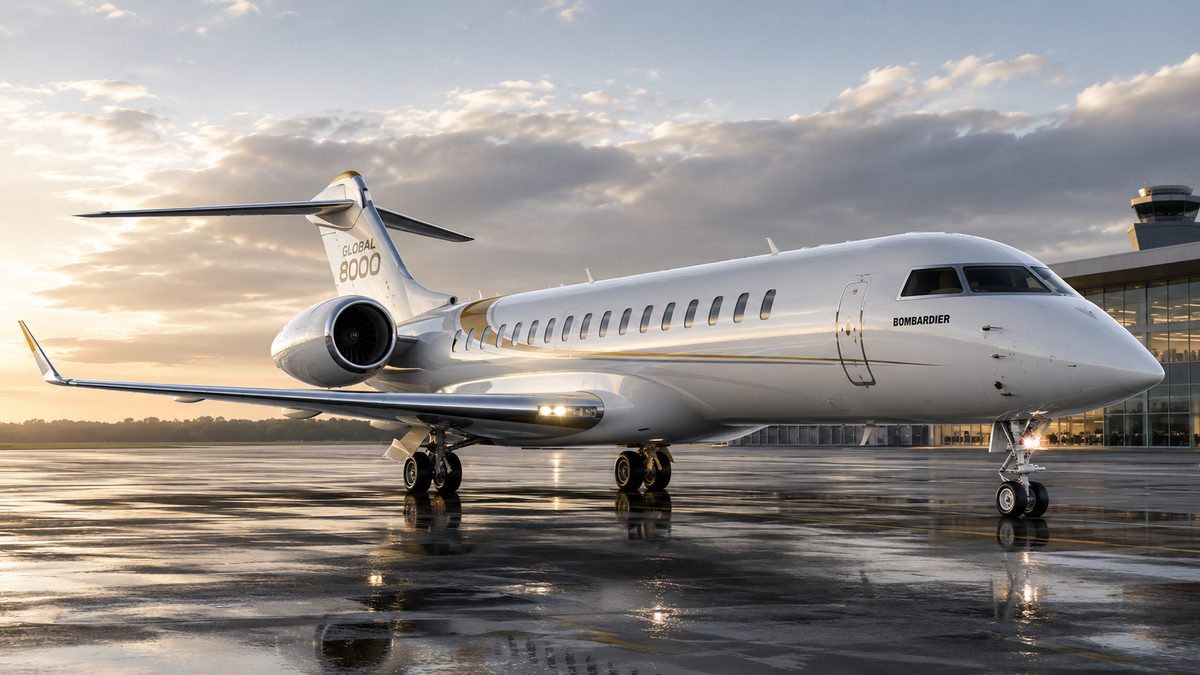
The Bombardier Global 8000 is an ultra-long-range private jet made for groups that need nonstop global travel. It seats up to 19 passengers, but 12 to 16 people usually get the most comfort.
Its published range is 8,000 nautical miles, so you can fly routes like Dubai to Los Angeles or Singapore to San Francisco in the right conditions. The aircraft can reach Mach 0.94, putting it among the fastest business jets.
You get four cabin zones, including a private suite, a crew rest area, and a large baggage compartment. This means your group can work, eat, sleep, and relax without crowding into one space.
Gulfstream G700
The Gulfstream G700 is a large-cabin ultra-long-range jet that seats up to 19 passengers. Most charter layouts carry 13 to 16 people, with a dedicated dining area and sleeping space.
It offers a range of about 7,750 nautical miles at its long-range cruise speed. You can use it for long group trips between cities like New York and Hong Kong, depending on winds and payload.
The cabin can include up to five living areas. Big windows, low cabin altitude, and a quiet interior help your group stay comfortable on long flights.
The G700 also cruises up to Mach 0.90. It’s a great fit if your group values cabin space but also wants fast travel.
Gulfstream G800
The Gulfstream G800 focuses on range and speed while keeping the same wide-cabin feel as other Gulfstream heavy jets. It can carry up to 19 passengers, but most group setups seat 12 to 16.
Its range reaches about 8,000 nautical miles, which puts it in direct competition with the Global 8000 for longest-range private jet. This range can cut out fuel stops on long intercontinental trips.
The G800 can fly up to Mach 0.925. Its cabin supports up to four living areas, so you can split up work, meals, rest, and sleep spaces.
The G800 works well when nonstop range matters more than squeezing in the maximum number of passengers.
Bombardier Global 7500
The Bombardier Global 7500 is one of the most popular ultra-long-range private jets. It seats up to 19 passengers and has four distinct cabin zones.
With a range of about 7,700 nautical miles, the Global 7500 handles many nonstop long-haul missions. It can connect cities like London and Santiago or Los Angeles and Sydney under the right conditions.
The cabin includes a full-size bed in the principal suite, a dining area, and a separate crew rest section. The big baggage compartment stays accessible during flight.
The Global 7500 can reach Mach 0.925. If your group needs a proven heavy jet with strong range and several private spaces, it’s a solid choice.
Gulfstream G650ER
The Gulfstream G650ER is a well-known ultra-long-range jet for groups of 10 to 16 travelers. It can seat up to 19 passengers, but many cabins use fewer seats for better sleeping and meeting areas.
Its range of about 7,500 nautical miles supports nonstop intercontinental group travel. The G650ER can fly from New York to Dubai or London to Buenos Aires if conditions are right.
It has a wide cabin with up to four living zones. You can set up a forward galley, club seating, dining table, and a private aft cabin.
The G650ER hits Mach 0.925 at top speed. While newer models offer a bit more range, the G650ER still stands out for its long service record and broad charter availability.
Dassault Falcon 10X
The Dassault Falcon 10X is a future ultra-long-range jet built for big groups and long routes. Dassault plans a cabin that can seat up to 19 passengers, with space for lounge, dining, and sleep areas.
Expected range is about 7,500 nautical miles. Top speed should be Mach 0.925, putting it among the fastest business jets.
The cabin is designed to be wider and taller than earlier Falcon models. You’ll get a large private suite, full bed, shower option, and separate crew area.
The Falcon 10X wasn’t in service as of July 2026, so you can’t charter or operate it yet. Treat its range, speed, and delivery timing as targets for now.
Dassault Falcon 8X
The Dassault Falcon 8X is a three-engine ultra-long-range jet that usually seats 12 to 14 passengers. It can carry up to 16 passengers in a denser setup.
With a range of about 6,450 nautical miles, it supports long trips like Paris to Tokyo or New York to Moscow without a stop. The three-engine design also opens more route options at certain airports and overwater routes.
The Falcon 8X has a long, narrow cabin with three separate zones. You can create areas for meetings, meals, and rest, though it’s not as wide as a Global or Gulfstream.
It works best when you need long range, access to shorter runways, and a cabin for around 10 to 14 people.
Dassault Falcon 6X
The Dassault Falcon 6X is a large-cabin heavy jet that usually seats 10 to 14 passengers. It can carry up to 16, depending on the interior and flight length.
Its range is about 5,500 nautical miles, covering many North Atlantic, U.S. coast-to-coast, and Middle East routes. You might need a fuel stop for the longest global trips.
The Falcon 6X has one of the tallest cabins in business aviation. Its height—about 6 feet 6 inches—gives taller travelers more room to stand and move.
You get three cabin zones, a large galley, and plenty of baggage space. This jet fits when you want a modern cabin for a group but don’t need the longest range.
Embraer Lineage 1000E
The Embraer Lineage 1000E is closer to a private airliner than a standard business jet. It can seat up to 19 passengers and offers five separate cabin areas.
Its range is about 4,600 nautical miles, so it handles many long trips but may need fuel stops on really distant routes. It suits larger groups who care more about interior space than extreme range.
You can have a private bedroom, walk-in shower, dining room, lounge, and office space. The big cabin lets your group spread out instead of crowding into one lounge.
The Lineage 1000E has a large baggage hold. It’s a great pick for families, executive teams, or touring parties traveling with more luggage and equipment.
Airbus ACJ320neo
The Airbus ACJ320neo gives you way more cabin area than traditional heavy jets. It’s a private version of the Airbus A320neo airliner and can carry up to 25 passengers in a typical executive setup.
Its range is about 6,000 nautical miles, so you can fly nonstop between lots of major global cities. Actual range depends heavily on cabin layout, passenger count, baggage, and fuel reserves.
The wide cabin can include a dining room, conference area, private bedroom, bathroom with shower, lounge, and crew rest space. Large groups can walk around and hold meetings in flight.
The ACJ320neo isn’t built for the speed of the fastest private jets. You’d pick it for airline-sized cabin space, not if you need the smallest or fastest aircraft.
Matching the Jet to the Mission
Your route, passenger count, baggage, and time on the ground should guide the aircraft choice. A jet that fits 10 people for a two-hour trip might not work for 15 passengers on an overnight international flight.
International Executive and Family Travel
If you're flying internationally with a larger group, opt for long-range private jets that have enough seats for everyone to eat, rest, and work in comfort. Jets like the Gulfstream G650ER, Bombardier Global 7500, and Dassault Falcon 8X usually have space for 10 to 14 passengers and feel surprisingly roomy.
These aircraft come with enclosed lavatories, full galleys, crew rest areas, and big baggage holds. That’s a lifesaver when you’re traveling with family, assistants, security, or a whole executive team.
A typical long-range jet can handle flights like New York to London or Los Angeles to Tokyo with fewer stops than smaller aircraft. Still, always double-check the actual range with your planned group and luggage, since headwinds and full cabins can cut down on how far you’ll get nonstop.
If your group hits 15 or more, you might want to look at an airliner-based option. The Boeing Business Jet (BBJ) gives you a lot more cabin space than even the largest private jets, though it does cost more to operate and can’t always land at every airport.
Coast-to-Coast and Transcontinental Itineraries
For U.S. coast-to-coast flights, large-cabin and ultra-long-range jets are often the sweet spot for groups of 10 or more. The Gulfstream G500, Gulfstream G600, Bombardier Global 6500, and Dassault Falcon 6X all handle most transcontinental trips with ease.
Don’t just trust the published range numbers. A route like New York to Los Angeles might look easy on paper, but a full plane, extra luggage, or strong winds could mean you’ll need a fuel stop.
If your group mixes business and leisure, try to find a cabin with at least three separate areas. That way, some folks can work while others relax or grab a bite.
Key checks for coast-to-coast trips:
- Make sure seating actually works for everyone, not just the max legal count
- Confirm baggage space for every traveler
- Check Wi-Fi strength for in-flight work
- Look at airport access on both ends
Sports Teams and Larger Delegations
Sports teams and big delegations usually outgrow even the largest private jets. Once you’re hauling 16 to 19 people, an airliner or VIP narrow-body might make more sense than splitting up into smaller jets.
A BBJ works well for teams, with wide aisles, tons of baggage space, and seating layouts meant for big groups. Team gear, medical kits, uniforms, and staff bags can eat up a lot of space, so plan cargo as carefully as you do seating.
For even bigger groups, the BBJ 787 (Boeing Business Jet 787) offers a wide-body cabin and can go intercontinental. It’s perfect for major teams or touring groups, but you’ll need airports with the right runways and services.
Don’t forget to check crew-duty limits, catering, and ground transport before booking. A big jet keeps everyone together, but it also makes planning more involved.
Cabin Features That Matter on Longer Flights
For groups of 10 or more, cabin layout really affects how well you can work, rest, eat, and just move around during the flight. Don’t just count seats—look for usable space, solid Wi-Fi, sleeping setups, and separate zones for different needs.
Work, Meetings, and Entertainment
A spacious, stand-up cabin lets people move around without bugging those who are working or sleeping. Flat floors help too, making it easier to gather around a conference table or just walk through the cabin without tripping over steps.
If business is the main goal, go for jets with Ka-band internet when you can. It’s good enough for email, video calls, sharing files, and streaming, though speeds can dip depending on where you’re flying and how many people are online.
A four-zone cabin is a game-changer. You can have meetings in one area, dine in another, set aside a quiet space for naps, and keep a rear lounge for entertainment.
Look for these features:
- Conference table with power outlets and USB charging
- Big monitors and wireless device hookups
- Noise-reducing cabin design
- Separate areas for small meetings
Sleep, Wellness, and Arrival Readiness
On overnight or long-haul flights, you’ll want more than just reclining seats. Private suites or enclosed sleeping spots give travelers a quieter, more private place to sleep, change, or get ready before landing.
Ask how many real beds the jet has—not just how many seats recline. If you’ve got 10 people, you might need a mix of full beds, divans, and lie-flat seats, especially if several folks have to hit the ground running.
Cabin altitude plays a role too. Lower cabin pressure can help cut down on jet lag and fatigue, making long flights a bit more bearable. Some newer jets offer circadian lighting that adjusts color and brightness to help you sleep or wake up as you cross time zones.
A good lavatory, fresh air, and easy temperature controls all add up to a much nicer experience on long flights.
Luggage, Catering, and Privacy
You want an aircraft that can haul people, bags, and supplies without forcing tough choices. If you’ll need access to coats, work gear, medicine, or personal bags during flight, make sure the baggage area is reachable from the cabin.
For groups, a full-size kitchen is a must. It lets the crew serve real meals, keep drinks cold, heat food, and manage service without crowding the cabin.
Talk through catering before you leave. Plan meal times, dietary needs, kids’ menus, and whether you want a formal dinner or boxed meals for a working group.
Privacy matters, especially with mixed groups. A four-zone cabin lets executives, families, staff, or guests have their own space, but everyone still travels together.
When a Smaller Jet Is a Better Fit
A smaller jet can be perfect if your group is close to 10, the flight is regional, and you want access to more airports. Think about passenger count, baggage, range, and runway limits before you pick.
Super-Midsize Options for Groups Near 10
Super-midsize jets are the next logical step down from large-cabin aircraft for groups of 10. The Bombardier Challenger 350 and the newer Challenger 3500 usually seat up to 10, while the Cessna Citation Longitude can handle up to 12 in some layouts.
The Embraer Praetor 600 also seats up to 12, depending on how it’s set up. It’s got the range for long U.S. trips and some international flights, using less fuel than a heavy jet when you don’t need all the extra space.
| Aircraft | Typical Maximum Seats | Best Use |
|---|---|---|
| Challenger 350 / 3500 | 10 | U.S. business trips with full cabins |
| Citation Longitude | 12 | Groups needing extra seats and range |
| Praetor 600 | 12 | Longer trips with flexible cabin layouts |
Before booking, double-check the actual seating plan. Sometimes a 10-seat layout squeezes out space for big bags, golf clubs, or catering gear.
Light and Midsize Jets for Shorter Regional Trips
Midsize jets work for smaller groups or trips where you don’t need every seat filled. The Citation Latitude holds up to nine, so it’s not quite enough for 10 unless you use two jets. It’s best for parties of eight or nine staying within its range.
Light jets like the Embraer Phenom 300 and Phenom 300E can be configured for more, but they’re most comfortable with six to eight people. You’ll notice less cabin width, not as much baggage space, and shorter range than the super-midsize jets.
The Pilatus PC-24 can seat up to 10 and is handy for short hops. Its cabin isn’t as big as the Challenger 350, but it can get into airports where many business jets can’t land.
Airport Access and Operational Flexibility
Smaller jets can use shorter runways and airports that get you closer to your final stop. That can save a lot of time, especially if you’re headed to smaller cities, resorts, or remote job sites.
The PC-24 stands out since it can handle some unpaved runways when conditions are right. The Challenger 3500, Citation Longitude, and Praetor 600 have advanced avionics and modern controls for efficient flights, but still need good paved runways.
Features like enhanced vision systems help pilots in low-light, though rules apply. Don’t mix these up with the Symmetry Flight Deck—that’s for the Cirrus Vision Jet, which isn’t really built for 10 people.
Charter, Jet Cards, Fractional Shares, and Ownership
How you access a jet depends on how often you fly, how set your schedule is, and which jet category fits your group. Usually, a super-midsize, heavy, or ultra-long-range jet offers the space you need for 10 or more.
On-Demand Charter for Occasional Group Trips
A private jet charter lets you book a jet for each trip without any long-term commitment or big upfront costs. That’s ideal if you only fly privately a few times a year or your group size and needs change often.
With on-demand charter, you can pick the right jet for each trip. Maybe a super-midsize for a 10-person domestic flight, or a heavy jet if you want more room and nonstop range.
Charter prices swing with aircraft supply, airport fees, repositioning, fuel, and peak dates. Always ask for an all-in quote that lists taxes, crew, de-icing, catering, and any overnight costs.
Jet Cards for Repeatable Access and Budget Control
A jet card lets you prepay for flight hours or deposit funds with a provider. Jet cards often set hourly rates by aircraft category, which can make costs more predictable than booking each trip on its own.
You might pick a program tied to a jet class—like super-midsize or heavy—rather than a specific model. For 10 or more, confirm guaranteed seating, baggage limits, cabin layout, and whether the provider can swap in a different jet.
Read the contract before you fund it. Watch for peak-day surcharges, minimum flight times, booking notice, expiration dates, cancellation rules, and what happens if there’s a mechanical delay. Programs like BlackJet may offer different fleets and terms, so compare the written rules, not just the rates.
Fractional and Whole Ownership Considerations
Fractional ownership means you buy a share of a specific aircraft type, with access based on your share. It’s good for frequent flyers who want reliable access but don’t want to handle every detail.
You’ll pay an acquisition cost, monthly fees, and hourly charges when you fly. That usually covers crew, maintenance, insurance, and admin, but details vary by program.
Private jet ownership gives you ultimate control over the aircraft, schedule, cabin, and crew. It’s also the biggest financial leap: you’re on the hook for purchase price, hangar, maintenance, salaries, insurance, training, and ongoing costs whether you fly or not.
If you’re filling 10 or more seats regularly, ownership can make sense for consistent travel. Still, compare your annual hours, trip range, and costs against fractional, jet cards, or just chartering.
Technology and Sustainability Considerations
For groups of 10 or more, you need reliable cabin tech, solid range, and safety features that keep things running smoothly. It’s also smart to look at fuel use, Sustainable Aviation Fuel options, and real-world ways to cut your carbon footprint.
Performance, Safety, and Flight Deck Innovation
Pick an aircraft with a range that matches your route so you don't have to stop for fuel all the time. Cutting out extra stops usually saves time and avoids those extra takeoffs that burn a lot of fuel.
Take the Rolls-Royce Pearl 700 engines on the Gulfstream G700, for example. They let you fly longer and use fuel more efficiently than older engines.
Modern fly-by-wire controls let pilots manage the jet with computer-assisted inputs. These systems lighten the workload and help prevent unsafe maneuvers.
You'll want advanced avionics too—think satellite weather, traffic alerts, and runway awareness tools. Enhanced vision systems use infrared cameras so pilots can see runways and obstacles, even when visibility stinks.
These features don't replace pilot judgment, but they really help with situational awareness during landing.
Sustainable Aviation Fuel and Carbon Strategy
Ask your charter provider about SAF compatibility before you book. Many newer large-cabin jets can use approved blends of sustainable aviation fuel mixed with regular jet fuel, but it depends on the airport and local rules.
SAF can cut lifecycle carbon emissions because it's made from stuff like waste oils or crop leftovers instead of fossil fuels. It's not zero-emission, though, and you might have trouble finding it at some airports.
For a practical carbon strategy, look for nonstop routes and pick an aircraft that's actually the right size for your group. Operators who can source SAF at your departure or arrival airport are a plus.
You can use third-party carbon programs to handle leftover emissions, but don't rely on offsets alone as a carbon-neutral flights solution. Direct fuel savings and SAF use make a bigger difference.
Frequently Asked Questions
If you're traveling with 10 to 15 people, things like cabin space, baggage room, flight range, and seating layout matter just as much as the official passenger limit. Large-cabin, super-midsize, and heavy jets usually strike the best balance for these trips.
Which private jets offer the most comfortable seating for groups of 10 or more passengers?
For 10 to 12 people, the Bombardier Challenger 3500, Cessna Citation Longitude, and Embraer Praetor 600 give you comfortable cabins with stand-up headroom, enclosed lavs, and club seating.
For 12 to 15 passengers, step up to something bigger like the Gulfstream G650, Bombardier Global 6000, Dassault Falcon 8X, or Gulfstream G700. These jets have wider cabins, more seating zones, and bigger baggage compartments.
Honestly, cabin comfort depends on how many seats you actually fill. A jet built for 14 can feel a lot nicer with just 10 or 11 people—especially if you're flying more than four hours.
How much does it typically cost to charter a private jet for 10 to 15 people?
Hourly charter rates usually run from $8,000 to $18,000+, depending on jet size, route, aircraft age, and demand. Super-midsize jets often cost around $8,000 to $12,000 per flight hour.
Heavy and ultra-long-range jets can go for $12,000 to $18,000+ per hour. Longer trips might rack up extra crew overnight costs, airport fees, fuel surcharges, catering, and repositioning charges.
Say you take a five-hour flight on a heavy jet—you might pay $60,000 to $100,000 before taxes and extras. The price shifts depending on where the aircraft starts and finishes the trip.
What is the maximum luggage capacity on large-cabin private jets?
Large-cabin jets usually handle 15 to 25 standard suitcases, but it depends on bag size and how many passengers you have. Jets like the Global 6000, Gulfstream G650, and Falcon 8X offer bigger baggage holds than most midsize jets.
Some aircraft let you access your bags during flight. Others stash luggage in an external compartment you can't reach in the air.
If your group brings golf clubs, skis, big instruments, or bulky garment bags, check the cargo space before you book. Always ask about weight limits, too.
A full passenger load, heavy bags, and a long route can shrink the jet’s nonstop range.
Which aircraft are best for long-haul flights with larger groups?
If you've got a big group flying far, the Gulfstream G650, Gulfstream G700, Bombardier Global 6000, Global 7500, and Dassault Falcon 8X are top picks. They handle long international routes and carry 10+ people with more comfort than midsize jets.
Ultra-long-range jets can often do New York to London, LA to London, or Miami to Paris with minimal or no fuel stops. Of course, it still depends on winds, payload, and airport quirks.
For U.S. coast-to-coast trips, super-midsize jets like the Challenger 3500 or Citation Longitude might work for 10 passengers. Heavy jets just give you more space for people and bags on the same route.
How do private jet cabin layouts differ for groups traveling together?
Most large private jets mix club seats, divans, conference tables, and rear seating areas. Club seating puts four seats around two tables—great for meetings, meals, or just hanging out.
Some layouts throw in a three-seat divan or a bigger couch. These count toward the certified passenger total, but you might get less personal space than with individual chairs.
Heavy jets often split the cabin into two or three zones. Up front, you might have a lounge for group chats, then a dining area in the middle, and a quieter rear section for rest or privacy.
What factors should be considered when choosing a private jet for a group trip?
Start with your actual passenger count, not just the aircraft’s maximum capacity. If you’ve got 12 people with full-size luggage, a jet rated for 12 might feel cramped and run out of baggage space fast.
Match the aircraft’s range to your route. A fuel stop adds time and can break up the flow, especially if your group’s on a tight schedule.
You’ll want to look at a few other details too:
- Cabin height and width—tall folks and longer flights make this matter
- Baggage volume and weight limits for each traveler
- Seat layout for meetings, families, or just stretching out
- Enclosed lavatory and galley access
- Wi-Fi availability and in-flight entertainment
- Airport runway limits at your departure and destination
- Charter cost, including repositioning and airport fees