
Gulfstream G700 vs Global 7500: Which Jet Wins?
Compare the Gulfstream G700 and Bombardier Global 7500 on range, cabin size, speed, runway performance, operating costs and buyer fit.

Gulfstream G700 vs Bombardier Global 7500
Two of the most capable ultra-long-range business jets compete for the same buyers. We compare range, cabin size, runway performance, speed, operating economics and acquisition considerations.
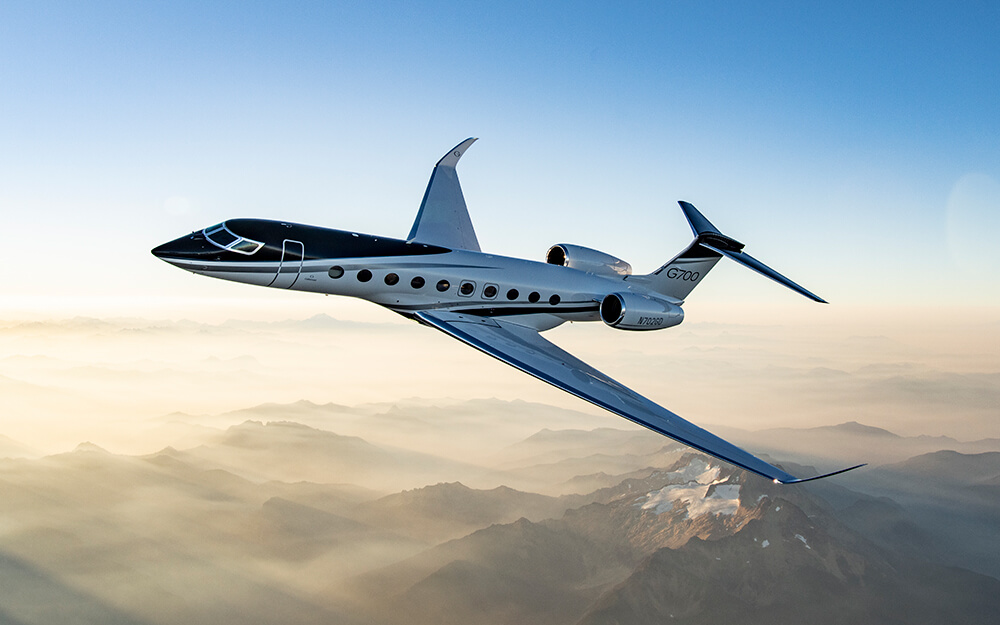

The Gulfstream G700 and Bombardier Global 7500 occupy almost exactly the same position in the business aviation market.
Both aircraft are designed for intercontinental operations, both can carry up to 19 passengers and both offer enough range to connect many of the world's major financial and commercial centers without refueling.
This makes the G700 vs Global 7500 comparison particularly relevant for private owners, family offices, corporate flight departments and governments evaluating a new ultra-long-range aircraft.
Buyers considering Gulfstream can also read our Gulfstream G700 review . Those considering access without ownership can compare Gulfstream G700 charter with Global 7500 charter .
The Short Answer
The G700 has the larger cabin, a slightly higher maximum operating speed and a published maximum range of 7,750 nautical miles.
The Global 7500 counters with stronger published takeoff performance, a larger established fleet and slightly more payload with maximum fuel under independent comparison data. Range is effectively a draw.
G700 Range
7,750 nm
Global 7500 Range
7,700 nm
Maximum Seating
19 / 19
Maximum Altitude
51,000 ft
Gulfstream G700 vs Global 7500 Specifications
| Specification | Gulfstream G700 | Bombardier Global 7500 |
|---|---|---|
| Maximum range | 7,750 nm | 7,700 nm |
| Long-range cruise | Mach 0.85 | Mach 0.85 |
| High-speed cruise | Mach 0.90 | Mach 0.90 |
| Maximum operating Mach | Mach 0.935 | Mach 0.925 |
| Maximum passengers | 19 | 19 |
| Cabin height | Approx. 6 ft 3 in | Approx. 6 ft 2 in |
| Cabin width | Approx. 8 ft 2 in | Approx. 8 ft 0 in |
| Cabin length excluding baggage | Approx. 56 ft 11 in | Approx. 54 ft 5 in |
| Living areas | Up to 5 | 4 |
| Internal baggage | Approx. 195 cu ft | Approx. 195 cu ft |
| Takeoff distance at MTOW | Approx. 5,995 ft | Approx. 5,760 ft |
| Maximum altitude | 51,000 ft | 51,000 ft |
| Engines | 2 × Rolls-Royce Pearl 700 | 2 × GE Passport |
Range Is Effectively a Draw
Gulfstream publishes a maximum NBAA IFR range of 7,750 nautical miles for the G700 at Mach 0.85 with eight passengers, four crew and reserves. Bombardier publishes 7,700 nautical miles for the Global 7500 under long-range cruise conditions.
A 50-nautical-mile brochure difference is immaterial in this category. Winds, routing, payload, alternates, reserves and cruise strategy can erase a margin of that size easily.
Independent comparisons reinforce the point. AvBuyer reported an eight-passenger available-fuel range of approximately 7,765 nautical miles for the G700 and 7,770 nautical miles for the Global 7500 under equivalent assumptions.
Buyer Takeaway
Do not choose between these aircraft because one brochure shows 50 nautical miles more range. Model the routes you actually fly with real passengers, luggage, winds and reserve requirements.
The G700 Has the Larger Cabin
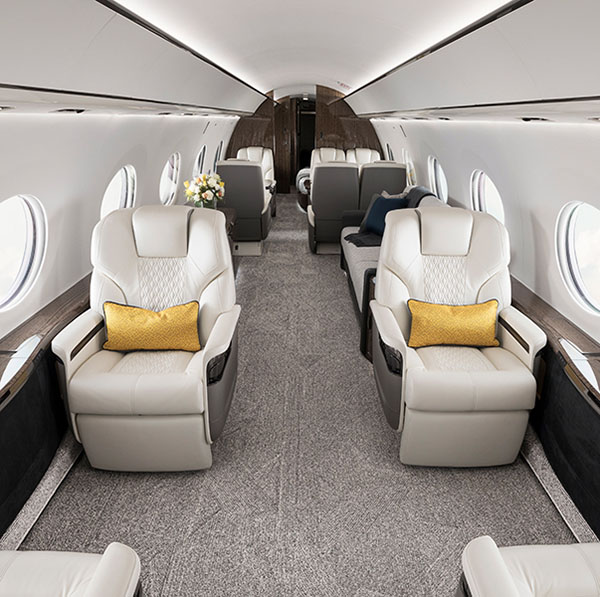
Cabin dimensions create one of the clearest differences between the two aircraft. Gulfstream lists a finished G700 cabin width of approximately 8 feet 2 inches and a height of approximately 6 feet 3 inches.
Its cabin length excluding baggage is approximately 56 feet 11 inches. The Global 7500 measures approximately 8 feet wide, 6 feet 2 inches high and 54 feet 5 inches long.
These are small numerical differences, but they extend across a cabin designed for flights that can exceed 12 hours. Buyers are not merely comparing seat dimensions. The aircraft can function as an office, bedroom, dining room and meeting environment during the same mission.
Where the G700 Wins
The Gulfstream gives buyers more cabin width, slightly greater height, additional overall cabin length and the possibility of five distinct living areas.
Gulfstream's large panoramic oval windows are also central to the cabin experience. The manufacturer states that the aircraft uses 100% fresh air replenished approximately every two to three minutes.
Bombardier approaches the cabin differently. The Global 7500 is designed around four full-size living areas and incorporates the Nuage seating system and Soleil lighting technology.

Speed Gives the G700 a Small Advantage
Both aircraft publish Mach 0.90 as a high-speed cruise figure. Gulfstream extends the operating envelope slightly further with a maximum operating Mach of 0.935 compared with Mach 0.925 for the Global 7500.
This should not be interpreted as a dramatic block-time advantage on every mission. Ultra-long-range operators balance speed with fuel burn, wind, reserves and arrival constraints.
The Real Buyer Question
At this level of the market, specification differences are small. The correct aircraft is usually determined by route structure, airfield access, passenger requirements, fleet commonality and the owner's preferred cabin environment.
Runway Performance Favors the Global 7500
Bombardier publishes a takeoff distance of approximately 5,760 feet for the Global 7500 at sea level, ISA conditions and maximum takeoff weight. Gulfstream lists approximately 5,995 feet for the G700.
The roughly 235-foot difference can matter more than the nominal range advantage because runway performance directly affects which airports are usable at a particular weight and temperature.
G700 Takeoff
~5,995 ft
Global 7500 Takeoff
~5,760 ft
Buyers operating regularly from hot, elevated or runway-constrained airports should run airport-specific performance calculations instead of relying only on headline takeoff figures.
Payload With Maximum Fuel Is Almost Identical
Buyers should examine payload with maximum fuel rather than treating maximum seating and maximum range as figures that can automatically be combined.
AvBuyer's August 2026 comparison placed available payload with maximum fuel at approximately 1,835 pounds for the G700 and 1,890 pounds for the Global 7500. The Bombardier advantage was only 55 pounds.
Operating Economics
Actual operating cost depends on utilization, fuel, maintenance programs, crew, insurance, hangar expense and mission length.
G700 estimated variable cost
$7,779/hr
Global 7500 estimated variable cost
$7,501/hr
AvBuyer's August 2026 comparison using JETNET data therefore gave the Global 7500 a modest hourly advantage.
On a representative 6,000-nautical-mile mission, estimated cost per nautical mile was effectively identical at approximately $12.25 for the G700 and $12.26 for the Global 7500.
The Global 7500 Has the Larger Installed Fleet
Bombardier's aircraft entered service earlier and consequently has the larger operating fleet. AvBuyer reported approximately 245 Global 7500 aircraft in operation by August 2026 compared with approximately 104 G700s.
Transaction activity was remarkably close, with approximately five Global 7500 transactions per month and 4.9 G700 transactions per month over the preceding 12 months.
Buyers considering debt or structured acquisition capital should also review our guide to financing options for aircraft acquisitions .
G700 fleet
~104 aircraft
Global 7500 fleet
~245 aircraft
Monthly transaction activity
~5 each
Engines and Flight Deck
The Gulfstream G700 uses two Rolls-Royce Pearl 700 engines and Gulfstream's Symmetry Flight Deck. The cockpit incorporates active control sidesticks, touchscreen interfaces and Gulfstream's Combined Vision System.
The Bombardier Global 7500 is powered by two GE Passport engines and uses the Global Vision flight deck. Bombardier's Smooth Flĕx Wing is central to the aircraft's handling and ride characteristics.
For an established corporate flight department, fleet commonality may carry more economic weight than individual cockpit features. Pilot qualifications, maintenance relationships, parts support and existing experience with either manufacturer can materially influence the acquisition.
Buyer Decision
Which Aircraft Fits Which Buyer?
Choose the Gulfstream G700 if
- You prioritize maximum cabin dimensions.
- You want up to five distinct living areas.
- You already operate Gulfstream aircraft.
- Mach 0.935 maximum operating speed matters.
- The panoramic-window cabin is a major ownership priority.
- Your regular airports do not make the runway difference decisive.
Choose the Global 7500 if
- Shorter-field performance matters to your route network.
- You prefer Bombardier's four-zone cabin layout.
- You value the larger established operating fleet.
- You already have Bombardier fleet commonality.
- Nuage seating and Soleil lighting appeal to your passengers.
- The slight maximum-fuel payload advantage matters to your missions.
G700 vs Global 7500: Which Should You Buy?
The G700 has the stronger cabin proposition. It is wider, slightly taller and longer, while offering the possibility of an additional living zone. It also holds a small advantage in maximum operating speed.
The Global 7500 has the stronger published takeoff figure and the larger established fleet. Independent comparison data also gives it marginally more payload with maximum fuel and a modest hourly variable-cost advantage.
Range does not meaningfully separate them. The final decision should be built around actual missions, passenger load, airport requirements, annual utilization, cabin preferences and existing operating infrastructure.
G700 vs Global 7500 FAQ
Which has longer range, the G700 or Global 7500?
Gulfstream publishes 7,750 nautical miles for the G700 compared with 7,700 nautical miles for the Global 7500. Under equivalent mission assumptions, their usable range is effectively tied.
Which aircraft has the larger cabin?
The G700 has the larger finished cabin. It is approximately 8 feet 2 inches wide and 6 feet 3 inches high and can be configured with as many as five living areas.
Is the G700 faster than the Global 7500?
Both publish Mach 0.90 high-speed cruise. The G700 has a maximum operating Mach of 0.935 compared with Mach 0.925 for the Global 7500.
Which aircraft requires less runway?
Bombardier publishes approximately 5,760 feet for the Global 7500 compared with approximately 5,995 feet for the G700 under headline maximum-weight conditions.
Which is better, the G700 or Global 7500?
The G700 is particularly strong on cabin size and maximum operating speed. The Global 7500 offers stronger headline runway performance and a larger established fleet. The better aircraft depends on the buyer's actual mission profile.
Compare the Full Economics Before Choosing the Aircraft
Aircraft acquisition should be evaluated alongside utilization, financing, depreciation, maintenance exposure, residual-value risk, leasing and charter alternatives.
Leasing vs Ownership Private Jet Operating Costs