
Benefits of a Configurable Executive Cabin
Assess the benefits of a configurable executive cabin: how flexible private-jet layouts affect productivity, privacy, payload, and daily mission economics.

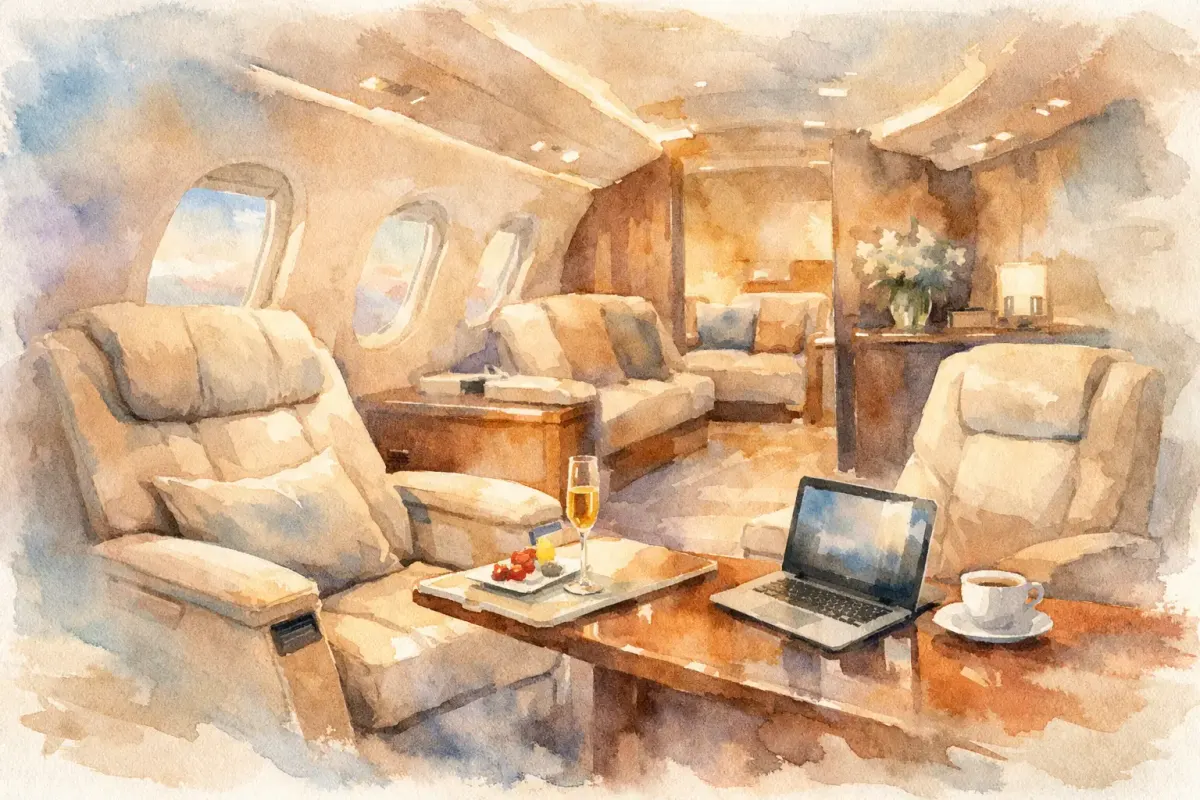
A cabin that works for a two-hour board meeting can be the wrong cabin for an overnight transatlantic sector. That is the commercial value behind the benefits of a configurable executive cabin: an aircraft interior can be arranged around the mission, rather than forcing every passenger group into one fixed layout. For executives, family offices and flight departments, the question is not simply whether a cabin looks premium. It is whether the layout improves travel time, protects confidentiality and supports the routes actually being flown.
A configurable executive cabin is most relevant on large-cabin and ultra-long-range aircraft, where operators have sufficient floor space to create distinct working, dining, rest and private zones. It can also matter on super-midsize aircraft, although the design choices are tighter and every seat removed or added has a clearer operational consequence.
Why configurable executive cabins matter
Private aviation missions often change faster than aircraft contracts. One week may involve a chief executive travelling with four directors from London to New York; the next may require an investor delegation, a family group, or a small team needing rest before a same-day meeting. A fixed high-density or purely lounge-led interior may suit one of those missions well and compromise the others.
Configurable cabins address this by allowing planned variations in seating, tables, dividers, sleeping arrangements and selected service areas. Depending on the aircraft and certification basis, changes may range from moving approved furniture modules to selecting between manufacturer-supported cabin schemes during acquisition or refurbishment. The practical scope matters. Not every attractive interior concept can be reconfigured between flights, and anything affecting seat tracks, emergency access, weight and balance or certification must be managed by an approved maintenance and design process.
For a business aviation buyer, the benefit is optionality with operational discipline. The cabin becomes a working asset aligned to passenger mix and route profile, not merely a capital-intensive furnishing decision.
The operational benefits of a configurable executive cabin
Productive work without sacrificing passenger comfort
An executive team travelling together needs more than Wi-Fi and a large table. They need a layout that allows discussion without exposing confidential material to accompanying staff, security personnel or other passengers. A configurable cabin can create a forward meeting zone with club seating and a conference table, while retaining a separate lounge or rest area aft.
This is particularly useful on sectors of four to eight hours, where passengers may need to work, eat and prepare for arrival within the same flight. On aircraft such as the Bombardier Global 6500, Gulfstream G650ER or Dassault Falcon 10X, multiple cabin zones make this separation more achievable. On a Challenger 3500 or Praetor 600, the objective is usually to optimise a single main cabin rather than create fully independent rooms.
The trade-off is capacity. A conference-focused arrangement may reduce the number of usable individual seats. Buyers should assess how often they genuinely travel with larger groups before giving up seating flexibility for a permanent boardroom configuration.
Privacy that supports decision-making
Privacy in business aviation is not limited to closed doors. It includes sightlines, acoustic separation, circulation paths and the ability for passengers to move through the cabin without interrupting a discussion. A well-planned executive configuration can position principal passengers away from the galley, crew rest area and entry door, reducing unnecessary traffic through the working zone.
For family offices, public-company executives and government travellers, this can be more valuable than adding another decorative feature. Sensitive conversations may begin before departure and continue until arrival. A partition, enclosed aft suite or dedicated meeting compartment can provide a better setting for those discussions than a large open-plan cabin.
However, partitions consume space and can make a cabin feel smaller when only two or three people are aboard. They are most effective when the operator has a repeatable privacy requirement, rather than an occasional preference for separation.
Better rest on long-range missions
On overnight sectors, cabin configuration has a direct effect on arrival readiness. Flat sleeping surfaces, a private suite and logical access to the lavatory can help passengers rest without disturbing colleagues. This is especially relevant on eastbound or westbound intercontinental itineraries, where poor sleep can reduce the value of an otherwise time-efficient private flight.
A configurable approach can allow a daytime working layout to become a more rest-oriented cabin for overnight travel. The strongest solution is usually not maximum bed count. It is a practical balance between sleeping positions, seating for awake passengers and sufficient space for cabin crew to provide service safely.
Operators should also consider how beds are made up, where bedding is stored and whether the aircraft has appropriate crew-rest facilities. A cabin can offer several nominal sleeping positions while still being operationally awkward on a 10-hour mission.
A stronger fit for mixed passenger groups
Many aircraft are used by more than one principal. A corporate flight department may serve senior leadership, technical teams and clients. A family office may combine business travel with family holidays. A dedicated lease may need to accommodate the lessee’s executives while retaining enough flexibility for occasional third-party or affiliate use.
In these cases, a configurable executive cabin reduces the need to choose between a purely corporate interior and a purely residential one. A four-place conference setting may support a management team on Monday, while a divan and entertainment-focused lounge can better suit a family itinerary later in the week.
This flexibility can improve utilisation, but it does not eliminate the need for clear cabin standards. Flight departments should define approved layouts, passenger limits for each layout, cleaning requirements, catering plans and turnaround time. Without those procedures, reconfiguration can become a source of dispatch friction rather than a benefit.
Financial and leasing implications
The cabin should be assessed as part of the aircraft’s economics, not separately from them. Bespoke interiors can differentiate an aircraft, but highly personal design choices may narrow resale appeal. A layout designed around one principal’s preferences may be less attractive to a future corporate buyer, charter operator or lease customer.
For an owned aircraft, the key question is whether the configuration supports the expected holding period and exit strategy. For a dedicated lease, the lessee should establish which interior changes are permitted, who pays for them, whether they must be reversed at redelivery and how downtime will be handled. A long-term lease may justify targeted upgrades; a shorter arrangement usually favours adaptable, reversible choices.
Charter availability introduces a further consideration. If an aircraft is expected to enter the charter market, a broadly useful executive configuration may support demand better than a niche interior. Yet there is no universal answer. A high-net-worth principal who values privacy above all else may accept a narrower resale market in return for superior mission fit.
Weight is another commercial factor. Heavy monuments, elaborate cabinetry and additional partitions affect payload and potentially range. On shorter sectors this may be immaterial. On routes near the aircraft’s range limit, extra cabin weight can influence fuel planning, baggage allowance or the need for a technical stop under adverse winds. The most compelling cabin is still a poor choice if it compromises a core mission such as nonstop New York to Dubai or London to Los Angeles.
How to evaluate the benefits before committing
Start with actual trip data rather than an idealised passenger experience. Review the last 12 to 24 months of travel: average passenger count, longest sectors, overnight frequency, number of confidential meetings, baggage patterns and routes where range margins were tight. This will reveal whether the aircraft needs a formal conference area, more sleeping capacity, increased luggage access or simply more comfortable individual seating.
Then test the layout against specific mission scenarios. A chief executive and two advisers flying London to Riyadh have different needs from eight colleagues travelling from New York to Miami. Ask where each person sits, where meals are served, how private calls are handled, when beds are deployed and whether crew can work without crossing the primary meeting area.
Finally, distinguish between factory options, certified retrofit work and genuinely quick-change modules. The first may be the most reliable and value-preserving route. The second can be effective but requires careful downtime, certification and cost planning. The third offers the greatest day-to-day flexibility, but only where the aircraft and operator have an approved system capable of supporting it.
A configurable executive cabin is most valuable when it is designed around repeated missions, not imagined occasions. The right layout should make the next demanding trip easier to conduct, easier to rest through and easier to justify commercially.