
Seasonal Demand And ACMI Leasing: How Airlines Adapt To Peak Travel Periods

Airlines face a constant challenge when passenger numbers change throughout the year. Summer vacations bring packed flights while winter months see fewer travelers. ACMI leasing provides airlines with aircraft, crew, maintenance, and insurance on flexible terms to handle these seasonal demand fluctuations without the cost of owning additional planes year-round.
When you need extra aircraft for peak travel seasons, ACMI wet leasing solutions let you add capacity quickly. You can lease planes for just a few weeks during busy periods or extend agreements for several months. This approach helps you avoid the financial burden of maintaining aircraft that would sit idle during slower seasons.
Airlines increasingly use ACMI to manage seasonal air travel demand because it offers operational flexibility. You can scale your fleet up during holiday rushes and scale back when demand drops. This strategy allows you to meet passenger needs while controlling costs and maintaining service quality throughout the year.
Key Takeaways
- ACMI leasing gives airlines flexible access to aircraft, crew, maintenance, and insurance without long-term ownership commitments
- Seasonal demand fluctuations can be managed effectively by scaling fleet capacity up during peak periods and down during slower months
- Strategic ACMI solutions help airlines reduce operational costs while maintaining service levels year-round
Understanding ACMI Leasing Models
ACMI aircraft leasing provides a complete operational package where the lessor supplies the aircraft, crew, maintenance, and insurance. The cost structure typically revolves around block hours, and understanding how ACMI differs from dry lease and damp leasing options helps you choose the right solution for your airline's needs.
Defining Key ACMI Components
The term ACMI stands for Aircraft, Crew, Maintenance, and Insurance. When you enter an ACMI lease agreement, the lessor handles all four components while you provide fuel and cover airport fees.
Aircraft means you get the physical plane ready to operate. Crew includes pilots, flight attendants, and technical staff who are trained and qualified. Maintenance covers all scheduled inspections, repairs, and regulatory compliance work. Insurance protects against hull damage, liability claims, and operational risks.
This full-service aircraft leasing model shifts operational burdens from your airline to the ACMI provider. You don't need to worry about crew scheduling, maintenance planning, or insurance policies. The lessor maintains operational control while you focus on selling seats and managing routes.
How Wet Lease, Dry Lease, and Damp Lease Differ
A wet lease is another name for ACMI, where you receive aircraft, crew, maintenance, and insurance together. Dry leasing means you only rent the aircraft itself and provide everything else including crew, maintenance, and insurance.
Damp leasing falls between these two options. You get the aircraft and crew but handle maintenance and insurance yourself. A CMI lease provides crew, maintenance, and insurance but you supply the aircraft.
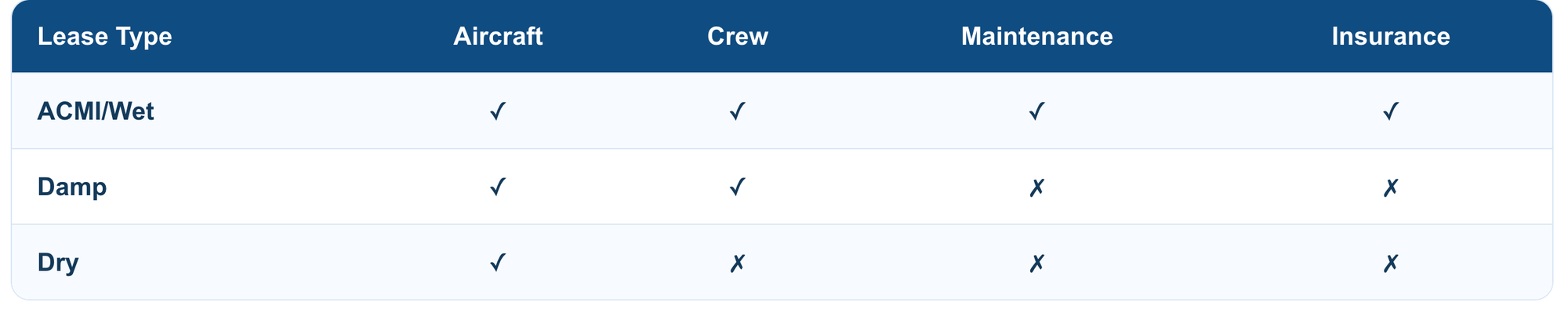
Wet leasing works best for short to medium-term periods when you need immediate capacity. Dry leasing suits longer commitments where you want operational control and have existing crew and maintenance infrastructure.
Block Hours and Cost Structure
Your costs in an ACMI lease are calculated based on block hours, which measure the time from when the aircraft leaves the gate until it arrives at the destination gate. You pay a fixed rate per block hour that covers all four ACMI components.
The rate includes crew salaries, maintenance reserves, insurance premiums, and aircraft ownership costs. Additional charges may apply for positioning flights, standby days, or minimum monthly guarantees. Leasing companies typically require a minimum number of block hours per month to ensure profitable operations.
This pricing model gives you predictable costs and eliminates the financial risk of owning aircraft. You can scale your fleet up or down based on actual flying hours without capital investment in planes or long-term crew commitments.
Role of Seasonal Demand in Airline Operations
Airlines face predictable surges in passenger traffic during holidays, summer vacations, and winter breaks that require careful planning to match fleet capacity with demand. These seasonal shifts create operational challenges around crew availability, aircraft deployment, and route profitability that you must address to maintain service quality.
Drivers of Peak Periods
Summer vacation months and major holidays drive the largest passenger volume increases for airlines worldwide. You'll see demand spike during June through August when families travel and schools close for breaks. Winter holiday periods including Christmas, New Year's, and spring breaks also create concentrated peaks.
Religious holidays like Hajj and Ramadan generate massive seasonal capacity needs in specific regions. Weather patterns influence demand too, as travelers head to warm destinations during cold months and cooler climates during hot seasons.
Key Seasonal Drivers:
- School vacation calendars
- Public holidays and long weekends
- Religious observance periods
- Weather-driven destination appeal
- Business travel cycles
Challenges of Mismatched Capacity
When your fleet capacity doesn't match seasonal demand, you face either lost revenue or wasted resources. During peak periods, you may lack sufficient aircraft and flight crew to serve all potential passengers. This forces you to turn away customers or miss profitable opportunities.
Crew shortages become particularly acute during high-demand windows when you need more pilots and cabin staff than your permanent workforce provides. You can't simply hire and train new crews for short periods since certification takes months.
Off-peak seasons create the opposite problem. Your aircraft sit idle and fixed costs continue while revenue drops. Maintaining year-round staff for seasonal routes means paying salaries during slow periods when you don't need full capacity.
Case Studies: Major Seasonal Peaks
European carriers experience their highest demand during July and August when passenger numbers can increase 30-40% above winter levels. You must deploy additional aircraft on Mediterranean routes and expand frequencies to popular vacation destinations. Airlines rely on flexible staffing models and ACMI partnerships to handle these summer surges.
Middle Eastern airlines face unique peaks during Hajj season when millions travel to Saudi Arabia within concentrated timeframes. You need substantial temporary fleet expansion that would be wasteful to maintain year-round.
North American carriers see Thanksgiving week demand that exceeds normal capacity by significant margins. This brief peak makes fleet expansion impractical, yet the revenue opportunity is too valuable to ignore. Airlines use seasonal capacity management strategies including route testing during these periods to evaluate new market opportunities without long-term aircraft commitments.
Strategic Use of ACMI for Seasonal Capacity Solutions
Airlines structure their ACMI solutions differently based on duration needs and operational goals. The choice between short-term arrangements, long-term planning, or hybrid models depends on your specific capacity challenges and route requirements.
Short-Term ACMI Arrangements
Short-term ACMI contracts typically last from a few weeks to several months. You can use these arrangements to handle immediate capacity needs during peak travel seasons like summer holidays or religious pilgrimages.
ACMI solutions for seasonal demand provide quick access to additional aircraft without long-term commitments. Your airline receives the aircraft, crew, maintenance, and insurance as a complete package. This approach works well when you face unexpected situations like aircraft groundings or sudden route expansions.
The main benefit is speed. You can deploy additional capacity within weeks instead of months or years. Your operational flexibility increases because you only pay for the aircraft during the period you need it.
Long-Term ACMI Planning
Long-term ACMI contracts extend beyond one year and often last multiple years. You might choose this option when planning comprehensive network development initiatives or testing new markets before purchasing aircraft.
These arrangements give you better rates than short-term deals. Your ACMI provider can dedicate specific aircraft and crew to your operations. This creates operational continuity and helps build team familiarity.
Long-term planning also supports fleet management strategies. You can use ACMI services while waiting for new aircraft deliveries or during fleet transitions. This maintains your capacity without gaps in service.
Hybrid and Custom ACMI Options
Hybrid models combine elements of both short and long-term ACMI services. You might secure a base level of capacity year-round with options to scale up during peak periods.
Custom arrangements let you tailor the agreement to your needs. Some airlines negotiate flexible terms that adjust based on actual demand patterns. Others create rolling contracts that extend automatically unless terminated.
Your ACMI provider may offer specialized configurations like specific aircraft types or crew language requirements. These customized capacity solutions address unique operational challenges that standard contracts cannot meet.
Benefits of ACMI Leasing for Airlines
ACMI leasing provides airlines with operational flexibility while reducing financial risk and creating new revenue opportunities. You gain immediate access to aircraft capacity without the long-term commitments of ownership or dry leasing.
Operational Flexibility and Rapid Deployment
You can respond quickly to market changes with ACMI aircraft that are ready to operate within days or weeks. The lessor provides the aircraft, crew, maintenance, and insurance coverage, allowing you to focus on route planning and passenger services.
ACMI leasing helps you manage seasonal demand fluctuations without maintaining excess capacity year-round. During peak travel periods, you can add aircraft to your schedule and return them when demand decreases.
You also benefit from operational support during unexpected situations. If your aircraft requires maintenance or heavy checks, an ACMI service fills the gap and protects your flight schedule. This maintains operational reliability for your passengers.
Key operational advantages include:
- Immediate capacity - Aircraft available in weeks, not years
- Fleet flexibility - Choose specific aircraft types for different routes
- No crew training - Lessor provides qualified flight and cabin crew
- Maintenance included - All technical support handled by the lessor
Risk Management and Financial Advantages
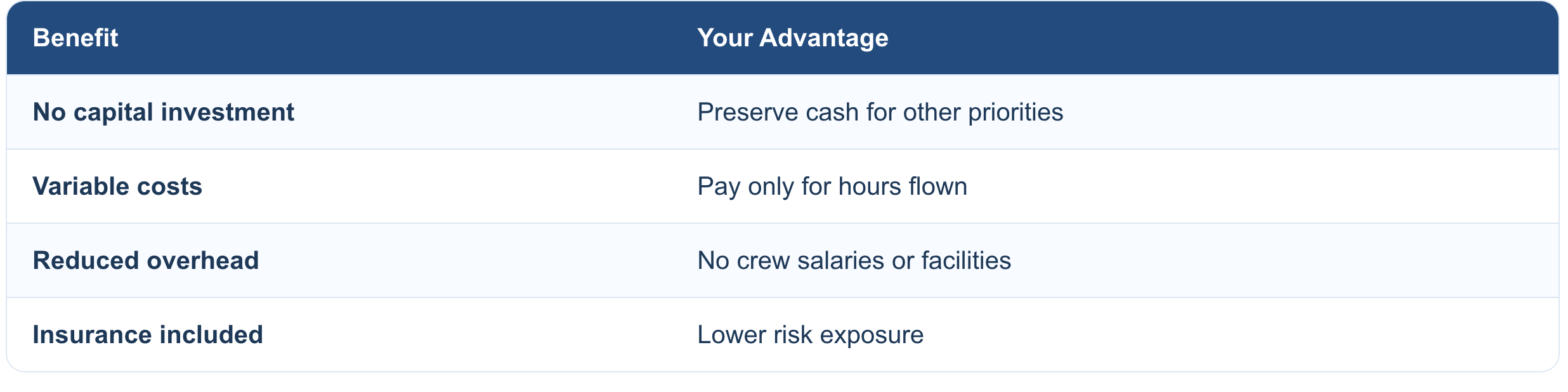
ACMI leasing shifts major operational burdens from you to the lessor. You avoid the capital expenses of purchasing aircraft and the fixed costs of crew salaries, training programs, and maintenance facilities.
Your risk mitigation strategy improves because the lessor handles insurance coverage, regulatory compliance, and technical issues. You pay only for block hours flown, converting fixed costs into variable expenses.
This payment structure protects your cash flow during slower periods. When you operate fewer flights, your ACMI costs decrease proportionally. You don't carry the burden of aircraft sitting idle or crew members without assignments.
Financial benefits:
Revenue Optimization and Market Entry
You can test new routes and markets without committing to permanent capacity. ACMI leasing lets you enter new markets quickly and evaluate passenger demand before making long-term fleet decisions.
Your revenue optimization improves when you match capacity precisely to demand. You avoid the costs of ground handling and airport fees for underutilized aircraft during off-peak seasons.
Fleet renewal becomes more manageable with ACMI support. When you transition between aircraft types or introduce new models to your fleet, ACMI aircraft maintain service continuity. You keep flying existing routes while your crew completes training on new equipment.
ACMI arrangements typically last from a few months to over a year, giving you flexibility to adjust as your business needs change. You can scale capacity up or down based on actual market performance rather than predictions made years in advance.
Selecting an ACMI Provider: Considerations and Leading Players
Choosing the right ACMI provider requires careful evaluation of their operational capabilities, fleet quality, and track record. The market includes several established leasing companies with different specializations and aircraft types.
Evaluating Provider Capabilities
You need to assess multiple factors when selecting an ACMI provider for your airline. Start by examining their operational history and reliability record. Look for providers with proven experience in your specific route network or geographic region.
Consider the provider's compliance standards and safety certifications. Your chosen partner should meet all regulatory requirements in the jurisdictions where you operate. Check their crew training programs and maintenance protocols.
Lead time requirements matter significantly for your planning. Cargo ACMI operations often require longer lead times than passenger services, so factor this into your scheduling. Some providers offer more flexible contract terms than others.
Evaluate their financial stability and insurance coverage. You want a partner that can maintain consistent service throughout your contract period. Ask about their backup aircraft availability in case of unexpected maintenance issues.
Key ACMI Providers and Leasing Groups
Several top ACMI providers dominate the 2026 market with different strengths and specializations. Avia Solutions Group operates one of the largest ACMI fleets globally. Chapman Freeborn provides flexible wet and long-term leasing solutions through their global network.
Other major players include dedicated ACMI specialists and traditional leasing companies that have expanded into wet leasing. Some providers focus exclusively on narrow-body aircraft while others maintain diverse fleets.
Charter operators sometimes offer ACMI services alongside their private jet charters and ad-hoc charter operations. This gives you access to additional capacity during peak periods.
Research each provider's market share and customer reviews. Talk to other airlines about their experiences with specific leasing companies.
Aircraft Types and Fleet Quality
The Boeing 737 and Airbus A320 families dominate narrow-body ACMI operations. These aircraft types offer the most flexibility for route planning and crew availability. Wide-body options exist but are less common in the ACMI market.
Fleet age and condition directly impact your operations. Insist on well-maintained aircraft with comprehensive maintenance records. Newer aircraft typically offer better fuel efficiency and lower maintenance delays.
Ask about the provider's maintenance facilities and quality control processes. Some leasing companies operate their own maintenance bases while others contract these services. Verify that all aircraft meet your technical specifications and cabin configuration requirements.
Converted passenger aircraft are common in cargo ACMI, but availability depends on conversion pipeline timing. If you need freighter capacity, confirm the aircraft's cargo certification status and loading capabilities.
ACMI in Fleet Expansion, Route Testing, and Operational Continuity
ACMI leasing provides airlines with immediate aircraft capacity during fleet transitions, supports market entry with minimal financial commitment, and maintains service reliability when unexpected disruptions occur.
Bridging Fleet Gaps and Transitions
Airlines face operational gaps when retiring older aircraft before new deliveries arrive. ACMI aircraft fill these transition periods without forcing you to commit to permanent fleet expansion. This matters especially when aircraft manufacturers delay deliveries or when supply chain issues extend maintenance schedules.
You can maintain your flight schedules during fleet replacement projects by bringing in ACMI capacity that matches your exact needs. The lessor provides the aircraft, flight crew, cabin crew, and handles maintenance while you focus on passenger service and ground services. This arrangement keeps your operations running smoothly even when your owned fleet sits in hangars waiting for parts.
ACMI leasing helps airlines avoid delays and financial burdens during critical fleet expansion phases. You get operational continuity without the capital investment required for purchasing aircraft outright.
Supporting New Route Launches
Testing new markets requires significant investment if you use permanent aircraft. ACMI leasing lets you launch routes with lower risk and faster deployment.
You can evaluate passenger demand on new routes for several months before deciding whether to allocate your own aircraft. If the route underperforms, you simply end the ACMI contract rather than repositioning owned aircraft or breaking long-term leases. If demand exceeds expectations, you maintain the ACMI arrangement until you secure permanent capacity.
The flexibility of ACMI for new routes and fast expansion makes it valuable for growth strategies. Your crew management teams can focus on training for permanent routes while ACMI providers supply fully staffed aircraft for experimental markets.
Handling Emergencies and Crew Shortages
Unexpected events disrupt even the best-planned operations. ACMI leasing provides immediate solutions when you face aircraft groundings, crew shortages, or sudden demand spikes.
When mechanical issues or required inspections remove aircraft from service, ACMI providers deliver replacement capacity quickly. You maintain your published schedules and avoid passenger compensation costs. The ACMI lessor manages crew management challenges by providing qualified flight crew and cabin crew who meet regulatory requirements.
Labor disputes or training backlogs can leave you without enough crew for your fleet. ACMI arrangements solve this by bringing fully staffed aircraft that operate under the lessor's crew management systems. Your operational continuity remains intact while you resolve internal staffing issues.
Frequently Asked Questions
Airlines face specific challenges when using ACMI leasing for seasonal operations, from understanding cost structures to navigating international regulations. These practical questions address the most common concerns about implementing ACMI solutions.
How does ACMI leasing help airlines manage peak travel seasons and unexpected demand spikes?
ACMI leasing gives you immediate access to additional aircraft capacity without the financial commitment of purchasing planes. When summer vacation travel increases or holiday bookings surge, you can add seasonal capacity for just the weeks or months you need it.
The lessor provides the aircraft, crew, maintenance, and insurance. You only handle fuel and airport fees. This arrangement lets you scale up operations quickly.
You can also use ACMI leasing to cover unexpected disruptions like maintenance delays or grounded aircraft. If your plane needs unscheduled repairs during peak season, an ACMI provider can deliver a replacement within days instead of weeks.
What are the main cost components and pricing structures in an ACMI lease agreement?
The lessor charges you for aircraft hours flown, typically measured in block hours from door close to door open. This rate covers the aircraft itself, flight crew salaries, maintenance programs, and hull insurance.
You pay separately for fuel, which represents your largest variable cost. Airport fees, ground handling, navigation charges, and landing fees also fall under your responsibility.
ACMI contracts usually include minimum monthly block hours, meaning you pay for a guaranteed number of flight hours whether you use them or not. Some agreements add positioning fees if the aircraft must ferry to your base without passengers.
When should an airline choose ACMI leasing instead of a wet lease, dry lease, or charter arrangement?
ACMI leasing and wet leasing refer to the same arrangement. Both terms describe when the lessor provides aircraft, crew, maintenance, and insurance while you cover operational costs.
You should choose ACMI over a dry lease when you need aircraft quickly or lack crew availability. Dry leases require you to provide your own crew and handle all maintenance, which works better for long-term fleet expansion.
Charter arrangements suit one-time flights or irregular schedules. ACMI makes more sense for regular routes over several weeks or months, especially when testing new markets before committing to permanent capacity.
What operational responsibilities do the lessor and lessee each assume under an ACMI contract?
The lessor maintains complete responsibility for the aircraft's airworthiness. They schedule and complete all maintenance checks, manage spare parts inventory, and ensure the plane meets safety standards. They also employ and pay the flight crew, including pilots and cabin attendants.
Your responsibilities focus on commercial operations. You plan the flight schedules, book passengers, and manage ticket sales. You purchase fuel at each airport and coordinate ground handling services.
You also handle route planning and obtain necessary slot permissions at airports. The lessor's crew flies according to your schedule, but you manage the business side of each flight.
How long do seasonal ACMI leases typically run, and what lead times are needed to secure aircraft?
Seasonal ACMI leases commonly run between two and six months to match peak travel periods. Summer season contracts often start in May and end in September, while winter holiday leases might cover December through February.
You should start looking for ACMI capacity at least three to four months before you need the aircraft. Popular aircraft types book up quickly during peak seasons, especially narrow-body jets suitable for European routes.
Some airlines secure ACMI agreements six months in advance to guarantee availability. Emergency situations requiring immediate coverage can sometimes be arranged within two weeks, but your aircraft choices will be limited.
What regulatory approvals and compliance requirements commonly apply when operating leased aircraft across borders?
You need an operating permit from your civil aviation authority before flying an ACMI aircraft under your flight code. This process verifies that the lessor meets safety standards compatible with your country's regulations.
Foreign aircraft operating in your network require approval from each country's aviation authority. European Union airlines benefit from EASA's unified certification system, but routes to other regions need individual country approvals.
Your ACMI contract must specify which air operator certificate (AOC) covers each flight. The aircraft typically operates under the lessor's AOC, but some countries require you to list the arrangement in your operations specifications. Insurance certificates need to show adequate coverage for all countries in your route network.